
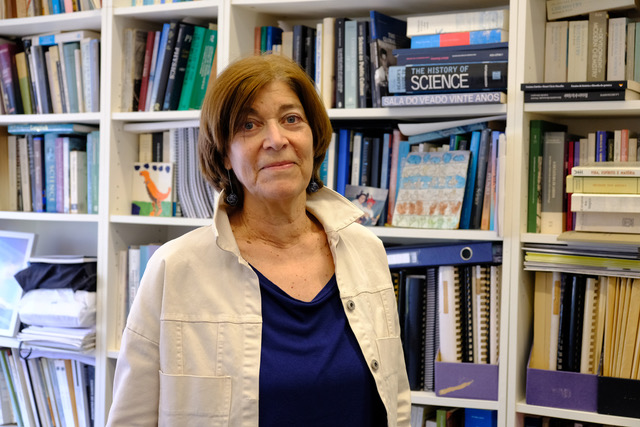
The Council of the ESHS is delighted to announce that Ana Simões has been awarded the Gustav Neuenschwander Prize for 2026.
The ESHS Council recognizes Professor Simões’s path-breaking, wide-ranging, and stimulating scholarship that has inspired generations of historians of science across the world to this day.
Following the Gustav Neuenschwander Prize award ceremony, Professor Simões will deliver a plenary lecture at the ESHS/HSS Joint Meeting in Edinburgh on 15 July 2026.
The nomination highlighted:
Her pioneering research on the emergence of quantum chemistry across Europe and the United States culminated in the landmark book Neither Physics nor Chemistry: A History of Quantum Chemistry (2011).
Her influential historiographical approaches to science in “peripheral” regions have challenged traditional center–periphery narratives and promoted more diverse, global, and interconnected histories of science.
The major research initiatives she has led on the urban history of science, technology, and medicine in Lisbon highlight themes of invisibility, coloniality, and scientific imaginaries in the making of the modern city.
Her prominent advocacy for inclusive, non-Eurocentric, and globally connected histories of science, with particular attention to Lusophone and postcolonial contexts.
Her contribution to fostering a new, internationally connected generation of Portuguese historians of science and technology has helped place Portugal firmly on the global map of the discipline over the past 25 years. This includes her decisive role in establishing undergraduate and graduate programs in history and philosophy of science in Portugal and in mentoring new generations of scholars and researchers.
Ana Simões’ academic biography
Ana Simões, born in 1958, earned an undergraduate degree in physics from the University of Lisbon in 1981. In 1988, she enrolled in the PhD program in History and Philosophy of Science at the University of Maryland, College Park, where she completed her dissertation in 1993 under the supervision of Stephen G. Brush. Her doctoral work focused on the emergence of quantum chemistry in the United States, a field to which she has continued to contribute throughout her career, also in collaboration with Kostas Gavroglu. Their work helped establish the history of quantum chemistry as a distinctive area of research, addressing questions of epistemology, disciplinary formation, reductionism, styles of reasoning, the role of contingencies, and the impact of computers on scientific practice.
After returning to Portugal, Ana Simões became a central figure in the development of the history of science and technology as a professional field in the country. Together with Ana Carneiro and Maria Paula Diogo, she participated in the European Union-funded Prometheus project (1994–1996), which studied the circulation of scientific ideas and practices in the European periphery and contributed to the revision of diffusionist narratives of the Scientific Revolution. This collaboration led to the formation of the collective persona known as the APAs — Ana Simões, Paula Diogo, and Ana Carneiro — and to their active role in the international network Science and Technology in the European Periphery (STEP). As founding members of STEP, they organized conferences, edited volumes, published extensively, and helped promote historiographical approaches attentive to the diversity of European scientific cultures.
Ana Simões is a Full Professor of History of Science at the Faculty of Sciences of the University of Lisbon, where she has played a leading role in creating postgraduate programs and a Minor in History and Philosophy of Science. She also contributed decisively to institution-building through the foundation of the open-access journal HoST and the creation of the Interuniversity Center for the History of Science and Technology (CIUHCT). From 2007 to 2019, she co-coordinated CIUHCT with Maria Paula Diogo during a period in which the center achieved the highest ranking in Portuguese research evaluations, significantly increasing the national and international visibility of the field.
Her research and institutional activity have combined the history of quantum chemistry, the history of science in Portugal, and broader historiographical debates on science, technology, peripheries, and European identity. Within the collective APAs, she has fostered international collaboration and promoted collective approaches to historical scholarship through participation in networks such as STEP and Tensions of Europe, as well as through extended stays at institutions including the Max Planck Institute for the History of Science and the Dibner Institute at MIT. As part of the APAs, she has also organized major national and international meetings, including STEP conferences in Lisbon in 2000 and 2014, the European Society for the History of Science conference in 2014, the Portuguese Meetings in History of Science and Technology from 2010 onward, and events connected to the Anthropocene Campus, the Anthropocene Summit, and the H2020 InsSciDE project.
Ana Simões has held several important positions in international scholarly organizations. She served in the presidential trio of the European Society for the History of Science from 2016 to 2022, including as president from 2018 to 2020 and remains a member of its Scientific Board. She has also served on advisory boards of major institutions, including the Max Planck Institute for the History of Science and the Max Planck Institute for Geoanthropology. More recently, she became President-Elect of the Division of History of Science and Technology, with her presidency to begin in 2029. Her career has been marked by a commitment to inclusivity, community building, interdisciplinary dialogue, and the role of the history of science and technology in addressing contemporary challenges.
At the national level, Ana Simões was among the first twenty women selected for Mulheres na Ciência (Women in Science) by the National Agency for Scientific and Technological Culture-Ciência Viva in 2015, recognizing outstanding contributions by women in the sciences broadly conceived. In 2024, she received the Scientific Prize of the University of Lisbon in the area of History and Philosophy.